CTFs & labsFoundations
GitHub Secure Code Game
Practice finding and fixing software vulnerabilities; useful groundwork for securing agent applications.
FreeAvailable
Page inspected 2026-09-28Learn to secure, test, evaluate, and govern AI agents. Start with tool-using and coding-agent security: credentials, MCP, files, traces, and authorized scope. Broader foundations remain available.
Explore the libraryOur original threat model follows untrusted inputs through tool actions, review gates and execution boundaries. Built for students working with Apollo Watcher.
Recorded does not mean prevented. Learn which actions reach review—and which need independent controls.
Original learning aid · Reviewed 28 September 2026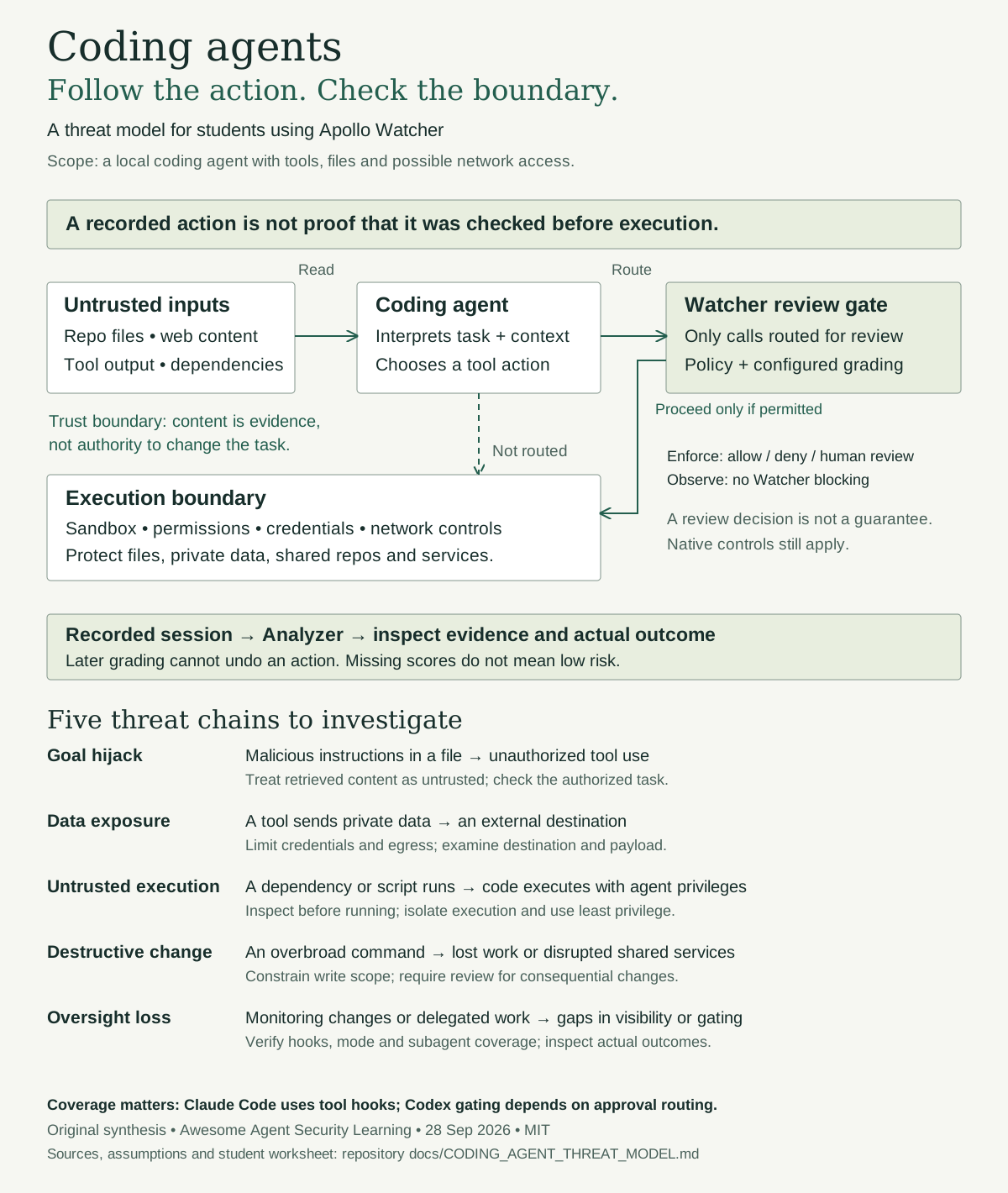
Follow the coding-agent / tool-using track
Use labs and testing tools only in environments where you have authorization.
Start with labs and tools, then deepen your understanding through guidance and research.
Showing 20 agent-specific resources
Practice finding and fixing software vulnerabilities; useful groundwork for securing agent applications.
Practice goal manipulation and prompt injection against a deliberately vulnerable invoice-processing agent.
Self-hosted prompt-injection challenges with tool use and multiple agent levels.
Research environment for evaluating prompt-injection attacks and defenses in tool-using agents.
Open-source gateway with documented JWT, API-key and OAuth authentication, fine-grained authorization, rate limits, TLS, and telemetry for MCP, A2A and model traffic. Quickstarts provide a starting point for studying agent access controls and observability; features were documented, not deployment-tested.
Runtime monitoring and control project for studying and managing agent behavior.
Open-source (GPLv3) autonomous penetration-testing platform, built and maintained by ASC-IT (the Darkmoon team). An LLM orchestrates specialist agents and offensive tools over a controlled, logged MCP interface, running on local models (Ollama, llama.cpp) or cloud providers (Anthropic, OpenAI, OpenRouter). Instructive for studying how an agentic system plans and chains tools end to end, and how an MCP gatekeeping layer and a local Privacy Gateway (reversible tokenization of real IPs, hosts and credentials) constrain it. Each finding is documented with the exact command run and its raw output; exploit confirmation is agent-asserted (re-tested only in the paid Pro tier), not a guaranteed real exploit. The free Community edition is a CLI/SDK; the web dashboard and remediation-to-pull-request are paid Darkmoon Pro. Advanced / disposable-lab setup only: the default docker-compose uses host networking, runs as root, and mounts the Docker socket and kubeconfig, so run it only against an authorized throwaway lab, never a daily-use machine or production.
Open-source framework for identifying generative AI risks through adversarial testing.
LLM vulnerability scanner useful for learning about model-level risks within agent systems.
Vendor-maintained (Continuum AI) archive of publicly disclosed AI agent security events, including incidents, vulnerabilities, research and policy. Distinguishes confirmed harm from demonstrations and labels disputed records and broader AI infrastructure. Source-linked case studies; verify individual cases against their cited sources.
Original infographic and student worksheet tracing coding-agent threats, Watcher review coverage and independent execution controls. Includes primary sources and a harmless classroom exercise.
Working group exploring runtime controls and governance for autonomous actions.
Background on the foundation and projects including MCP, goose, and AGENTS.md; an ecosystem orientation resource.
Official guidance on authorization, confused-deputy risks, token handling, and other MCP security concerns.
Voluntary framework for governing, mapping, measuring, and managing AI risk. Foundation for agent governance; not a certification.
Threat models, community guidance, and security workstreams for autonomous agents.
Advanced AI Society working draft on runtime evidence, authorization, and independent verification of agent actions, with schemas and reference artifacts. Distinguishes tamper-evident records from complete observation and gated execution. Public comment is open through October 30, 2026; draft claims are not established production guarantees.
Research on a harness-level authorization and data-provenance gate with deterministic decisions, without an LLM in the decision path. Reports limits involving transformations, legitimate reuse and observation coverage.
Research on agents altering local execution records. Examines trace custody and argues for independent interception outside the agent’s control; findings concern the tested configurations.
Benchmark separating task capability from scope adherence under goal pressure. Study of 30 tasks and eight models in one harness; useful for reasoning about rules of engagement, not a universal safety score.
Long-form interviews including AI risk, alignment, and governance; the feed also covers other topics.
Specialization combining agent development and security concepts. Verify enrollment and certificate terms.
AI security training catalog; select courses based on their syllabus and agent relevance.
Free, self-paced course with 21 lessons on MCP architecture, the OWASP MCP Top 10, incidents, and mitigations. Covers token exposure, privilege escalation, tool poisoning, supply-chain tampering, and command injection. The provider issues a verifiable course-completion certificate after a final quiz.
Vendor-produced training collection about AI agents and their security.
AWS microcredential assessing agent workload identities, tag-based access control, scoped JWT authorization, authentication methods, and token audit trails in a timed, live AWS lab. AWS states no Skill Builder subscription is required; passing earns a Credly badge. Distinct from AWS Certification.
Provider describes practical training in agent reasoning, memory, tool use, and multi-agent identity. Listed as coming soon when checked.
AI safety certificate program covering organizational practices and responsible adoption.
Security research blog with practical investigations of prompt injection, assistants, and agent attack surfaces.
Online textbook introducing AI risks, safety, ethics, and societal governance.
Agent engineering credential. Useful implementation background, not a dedicated agent-security certification.
Application-security conference recordings, including AI security content. Choose agent-specific talks within this broad channel.
Provider-described practical certification covering prompt injection, RAG poisoning, agent/tool abuse, and MCP attack paths. The associated bootcamp lists a 24-hour hands-on exam and an October 20, 2026 launch; verify current enrollment and assessment terms.
Instructor-led training focused on securing agentic AI systems. Check current dates and prerequisites with SANS.
Provider-described intermediate, four-hour practical exam with flag-based challenges against agentic applications accessed over VPN. Covers prompt injection, goal hijacking, tool abuse, memory, and multi-agent workflows. Prior application pentesting experience is recommended; the provider prohibits AI assistance during the exam.
SANS introductory webcast on approaching agentic AI security. Registration or replay availability may vary.
Technical explanations and commentary on prompt injection and the risks of tool-using AI systems.
Try a broader search or clear your filters to see the full library.
New resources arrive as pull requests for a maintainer to evaluate. Merging a proposal adds it here. Labels distinguish agent-specific learning from broader AI and foundational material. Inclusion is not an endorsement; verify availability and cost with each provider.
Read the curation policy